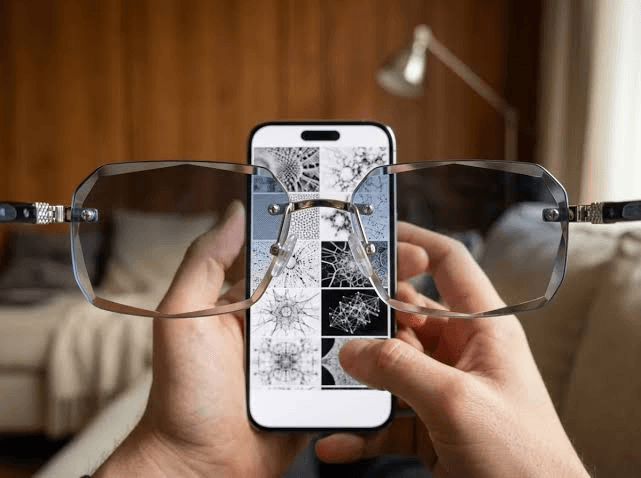
Reading glasses that darken in sunlight, with a blue-light
filter.
Ready-to-wear readers from +1.00 to +2.50 in one light frame
weighing under 1 oz. Made for menus, labels, phones and small
print, with an honest explanation of what each feature does.
BlueLume Glasses are non-prescription reading glasses for
near-vision tasks. They do not correct distance vision and are
not for driving. The blue-light filter has not been shown to
reduce digital eye strain. Have regular eye tests. Our goods
come with guarantees that cannot be excluded under the
Consumer Guarantees Act.
NZ-wide deliveryTotal shown before you
pay
30-day money-backOn top of your CGA
rights
GST includedAll prices in NZD
Not for driving, cycling or operating machinery.
Never look at the sun through any glasses. Safety notes
Quick
answers
Do they help with distance?
No. They're
readers for close-up tasks. Look over them or take them off to
see across the room.
Do blue-light glasses work?
A 2023
Cochrane review found they probably make little or no difference
to digital eye strain. We say so plainly.
Do photochromic lenses darken
in the car?
Hardly at
all. Most windscreens block the UV the coating needs. Don't
drive in reading glasses anyway.
How do I choose my strength?
Hold small
print at about 40 cm and pick the lowest strength that makes it
clear. Our printable chart helps.
Are they sunglasses?
No. We make
no UV or sunglass rating claim. Use sunglasses that meet AS/NZS
1067 for sun protection.
What do they cost?
$44.43 NZD
incl. GST for one pair, down to $35.54 a pair in a five-pack. See packages.
The product
What are BlueLume Glasses?
BlueLume Glasses are ready-to-wear reading glasses. Each lens
has the same magnifying strength, from +1.00 to +2.50, to make
close-up text and detail easier to see once your eyes find
focusing up close harder.
Every pair also has a photochromic coating that darkens when
it's exposed to UV light outdoors and clears again indoors, plus
a blue-light filter. The frame is rimless and weighs under 1 oz,
so it sits lightly through a long read.
They are a practical option for one job: seeing near things
comfortably. They don't correct distance vision, they aren't for
driving, and they don't replace an eye test. The rest of this
page explains why, and helps you decide whether they suit you.
Why near vision changes
Presbyopia: symptoms, age and what's happening
The lens inside your eye changes shape to focus on close
objects. With age it gradually stiffens, so focusing up close
gets harder. This is called presbyopia, and it's a normal part
of getting older rather than a disease.
Most people start to notice it some time in their 40s. Common
signs include holding your phone or a menu further away, needing
brighter light to read, and tired eyes or headaches after close
work. It usually keeps changing slowly into your 60s.
Reading glasses add magnification so close-up things come into
focus without your eye working as hard. They help with the
focusing problem only. They do nothing for the health of your
eye, which is why regular eye tests still matter.
Signs it's time for an eye test
Reading glasses aren't
enough. See an optometrist, and promptly for anything sudden.
Sudden change in vision
Flashes of light or new floaters
Eye pain or redness
Halos around lights
Double vision
One eye sees differently to the other
Headaches when reading
Diabetes, glaucoma or cataract diagnosis
Some eye care is publicly
funded in New Zealand for eligible groups. Your optometrist or
GP can tell you what applies to you.
Questions to ask your optometrist
1Are
ready-made readers fine for me, or do I need a prescription?
2Do
my two eyes need different strengths?
3Do
I have any astigmatism?
4What
strength suits my screen distance versus book distance?
5How
often should I come back for a check?
Features
Three features, explained honestly
Here's
what each part of BlueLume Glasses actually does, and where its
limits are.
1. Magnification
Both
lenses have the same plus strength, chosen from +1.00 to +2.50.
Higher numbers magnify more and suit a closer reading distance.
Because
they're set for close range, anything beyond arm's length looks
blurry. Look over the top or take them off when you walk around,
and take care on steps and kerbs.
2. Photochromic
coating
The
coating darkens when UV light reaches it outdoors and clears again
indoors, which makes reading outside more comfortable in bright
conditions.
It clears
more slowly than it darkens, darkens less in hot weather and
clears more slowly in the cold. It isn't a sunglass rating.
3. Blue-light
filter
The
lenses filter part of the blue light from screens and lighting.
Some people like the slightly warmer look it gives.
Research
has not shown that blue-light filters reduce eye strain, improve
sleep or protect the retina. See the evidence panel below.
How
photochromic lenses work
The coating contains molecules that change shape when ultraviolet
light hits them. In their changed shape they absorb more visible
light, so the lens looks darker. Indoors, away from UV, they
slowly return to their original shape and the lens clears.
Do transition-style lenses darken in the car?
Very little. Car windscreens filter out most UV, so the trigger
never arrives. That's one more reason reading glasses and driving
don't mix.
Photochromic readers aren't sunglasses. For a day in the sun,
wear sunglasses that meet AS/NZS 1067, and follow SunSmart advice.
Evidence
Do blue-light glasses work?
We include a blue-light filter because some people prefer it.
But we'd rather you know what the research says before you buy.
The best summary so far is a 2023 Cochrane systematic review.
It pulled together randomised trials of blue-light-filtering
spectacle lenses and looked at eye strain, sleep and eye health.
So we don't claim BlueLume Glasses protect your eyes, reduce
eye strain, or improve sleep. If screens leave your eyes tired,
the habits on the right have better support.
Cochrane review, 2023
Blue-light-filtering lenses probably make little or no
difference to eye strain from computer use, compared with
standard lenses, over the short term.
Our plain-language
summary of Lawrenson JG et al., Blue-light filtering
spectacle lenses for visual performance, sleep, and macular
health in adults, Cochrane Database of Systematic Reviews
2023. The review also found the evidence on sleep and macular
health uncertain.
Screen comfort: a 20-20-20 planner
Every 20 minutes, look at
something about 20 feet (6 m) away for 20 seconds.
0:20
Look out the window
0:40
Blink slowly ten times
1:00
Stand up and stretch
1:20
Refill your water
Keep the screen about an arm's length away
Match screen brightness to the room
Reduce glare from windows and lamps
Make text bigger rather than leaning in
Strength guide
How to choose reading glasses strength
Strength selection is a general guide. The simplest test is the
chart on the right: print it, or use a page of small print, and
hold it at the distance you normally read, around 40 cm.
1Without
glasses, find the smallest line you can read comfortably at 40
cm.
2The
strength next to that line is a sensible starting point.
3If
you're between two, choose the lower one. Too strong can feel
uncomfortable.
As a loose pattern, many people start around +1.00 to +1.50 in
their 40s and move higher over time, but plenty don't follow
that pattern. Age is not a rule.
If you need more than +2.50, your eyes need
different strengths, or no strength feels right, see an
optometrist.
Specifications
What's in a pair
We only list what our
product information confirms.
Ready-made readers have the same strength in both
lenses and assume a standard pupil distance and no astigmatism.
BlueLume Glasses specifications
Type
Non-prescription, ready-to-wear
reading glasses
Strengths
+1.00, +1.25, +1.50, +1.75, +2.00,
+2.25, +2.50 (chosen at checkout)
Use
Near-vision tasks only. Does not
correct distance vision.
Coatings
Photochromic and blue-light filter on
every pair
Frame weight
Under 1 oz (under about 28 g)
Style
Rimless lenses, silver-tone bridge,
black temple arms
Not suitable for
Driving, cycling, machinery, children,
looking at the sun
Returns
30-day money-back on unused glasses
Consumer rights
Consumer Guarantees Act and Fair
Trading Act apply
What you actually get
The benefits, honestly scoped
Clearer close-up
Small print,
phone screens and labels are easier to read at a comfortable
distance.
Comfier reading outside
The lenses
darken in daylight, so reading on the deck or at the beach feels
less glary.
Light to wear
A rimless
frame under 1 oz that's easy to forget you're wearing.
A dressier look
Faceted
rimless lenses and decorated hinges, rather than plain pharmacy
plastic.
Compare
Reading glasses vs prescription glasses vs multifocals
A fair
comparison by type. Prices vary a lot between retailers and
optometrists, so we haven't listed them.
Comparison of reading glasses types
Feature
BlueLume Glasses
Typical pharmacy readers
Photochromic readers,
specialist retailers
Prescription multifocals,
optometrist
Best for
Near tasks, indoors and
out
Near tasks indoors
Near tasks, indoors and out
Near, middle and distance
Corrects distance vision
No
No
No
Yes, to your prescription
Different strength per eye
No
No
Usually no
Yes
Corrects astigmatism
No
No
No
Yes
Photochromic option
Yes, every pair
Rarely
Yes
Usually available
Includes an eye-health check
No
No
No
Yes, with the eye test
Price
From $35.54 a pair in a
pack
Varies
Varies
Varies, usually much higher
One pair or
several?
Reading
glasses get used in lots of places, so a spare often saves the
hunt. That's the honest case for a pack. It's convenience, not
extra vision features.
One by the couch
For books, puzzles and the TV
guide.
One at work
No more carrying a single pair
back and forth.
One in the bag
For menus and receipts. Not for
wearing while you drive.
Share with family
Different strengths can be mixed
in one pack.
Safety, care and limits
Use them well, look after them
Safety
Not for driving, cycling or operating machinery,
including at night.
Mind steps and kerbs. Look over them or take them
off when walking.
Never look at the sun through any glasses.
Not suitable for children. Keep small parts away
from young children.
Not a substitute for an eye examination or
prescription glasses.
Lens care
1.Rinse off dust with
lukewarm (not hot) water.
2.Use a drop of lens spray
or mild soap.
3.Dry with a clean
microfibre cloth.
4.Avoid paper towels,
tissues and clothing.
5.Don't leave them on the
dashboard or in a hot car.
Limits to know
Same strength in both lenses; no astigmatism
correction.
The coating barely darkens behind glass.
No UV-protection or sunglass rating is claimed.
The blue-light filter isn't shown to reduce eye
strain.
Pricing
Choose your package of BlueLume Glasses
More pairs means a lower price per
pair. Share with family, keep a spare at the office, or stock up
for the year. All prices in NZD, GST included.
1
Select package
Savings are calculated
against our current single-pair price of $44.43.
2
Choose strength
Not sure? Use the printable
reading chart. In multi-pair packs you can mix strengths
at checkout.
Guarantee and returns
Your rights come first
Our goods come with guarantees that cannot be excluded under the
Consumer Guarantees Act 1993. If something goes wrong, you may be
entitled to a repair, replacement or refund depending on the
problem. Our 30-day money-back guarantee is in addition to these
rights.
30-day money-back
Return unused glasses in
their original condition within 30 days of delivery for a refund
of the product price to your original payment method.
How to claim
Contact us with your order
number before sending anything back, and we'll confirm the return
address and next steps.
Faulty glasses
If a pair is faulty, tell us.
We'll put it right under the Consumer Guarantees Act and cover the
return of faulty goods.
Your rights
This does not affect your
rights under the Consumer Guarantees Act or the Fair Trading Act.
FAQ
Frequently asked questions
What are BlueLume Glasses?
BlueLume Glasses
are non-prescription, ready-to-wear reading glasses for close-up
tasks such as menus, labels, phones and small print. Every pair
has a photochromic coating that darkens in UV light and a
blue-light filter, in a lightweight frame that weighs under 1
oz.
Do they correct distance vision?
No. They magnify
things that are close to you. Anything beyond arm's length will
look blurry through the lenses, so look over them or take them
off for distance. They do not replace distance or prescription
glasses.
Can I drive in them?
No. BlueLume
Glasses are not for driving, cycling or operating machinery.
Reading lenses blur the road ahead, and the photochromic coating
darkens very little behind a windscreen. They are also not for
night driving.
Do the lenses darken in the car?
Very little, if at
all. Photochromic coatings need ultraviolet light to darken, and
most car windscreens block UV. That is one reason they are not
suitable for driving and are not a replacement for sunglasses.
How fast do they darken and clear?
The coating starts
to darken when it is exposed to UV outdoors and clears again
indoors. Clearing is usually slower than darkening, and both
depend on how strong the UV is and on temperature: the lenses
tend to darken less in hot weather and clear more slowly in the
cold.
Do blue-light glasses work?
Not for eye strain,
according to current evidence. A 2023 Cochrane review (Lawrenson
et al.) found that blue-light-filtering spectacle lenses
probably make little or no difference to digital eye strain
compared with standard lenses, and found no clear evidence about
sleep or eye health. We include the filter, but we do not claim
it protects your eyes or improves sleep.
How do I choose my strength?
Hold our reading
chart, or a page of small print, at your usual reading distance
(around 40 cm) and pick the lowest strength that makes the text
clear and comfortable. Strength selection is a general guide
only. If you need more than +2.50, or none of the strengths
feels right, see an optometrist.
Can I use them if my eyes differ?
Ready-made readers
have the same strength in both lenses and assume a standard
distance between your pupils and no astigmatism. If your eyes
need different strengths, or you have astigmatism, prescription
glasses from an optometrist will suit you better.
Do they replace an eye test?
No. Ready-made
readers do not check the health of your eyes. Regular eye tests
can pick up conditions such as glaucoma, cataract and diabetic
eye disease early. See an optometrist promptly if you notice
sudden changes, flashes, floaters, eye pain or double vision.
Are they UV protective?
We do not make a
UV-protection or sunglass claim for BlueLume Glasses. The
photochromic coating reacts to UV, but that is not the same as a
tested UV rating. For sun protection outdoors, wear sunglasses
that meet AS/NZS 1067, and never look directly at the sun.
How do I clean them?
Rinse off dust with
lukewarm water, then wipe gently with a clean microfibre cloth
and lens spray. Avoid paper towels, clothing, hot water and
leaving them in a hot car, as heat and rough fabrics can damage
the coatings.
What is the return and warranty policy
in New Zealand?
You can return
unused glasses within 30 days of delivery for a refund under our
money-back guarantee. Contact us first and we will confirm the
return details. This does not affect your rights under the
Consumer Guarantees Act, which cannot be excluded.
Is the weight about 28 g?
The frame weighs
under 1 oz, which is under about 28 g, so it sits lightly for
reading sessions.
How do shipping and delivery work in
NZ?
We deliver to
addresses throughout New Zealand. Prices include GST, and the
full total for your order is shown before you pay.
Small print, made easier.
Light, rimless readers
that darken outdoors. Choose your strength, choose your pack, and
keep a pair wherever you read.